Showing posts with label Festival of Homiletics 2015. Show all posts

Thursday, June 18, 2015

Blogging the Festival - Barbara Lundblad, "What's a White Person To Do?"

One of the lectures I attended at the Festival of Homiletics was given by Barbara Lundblad and was titled, "I Haven't Been to the Mountaintop:  What's a White Person To Do?"  She began by telling a Fred Craddock story about how he had attended the opening of an African-American Church in Atlanta and at the reception after the service a 6-year old black boy came up to him and asked, "Are you a mean man?"  The boy's father later apologized to Fred and said that some days were so hard that he just came home and spoke his mind and that his son had heard him say things.

Barbara asked, "Does my whiteness make me mean?"

She asked a lot of questions and she shared a lot of statistics, specific statistics that I did not write down, about slavery and "ghetto loans," about "mud people" and banks targeting black churches, about bills that address the issue of reparations but never make it out of committees, about red lines and people as assets.  Some of what she said I knew.  Some I didn't.  She was observing the things that she did not know.  Things that make you scream or weep or both when you do know.  She said them without passion, as observation, not scolding.  She suggested that as preachers we need to expose and envision - to tell truth, not to shame people.  She said we can expose by simply turning on the tv or internet and sharing what we see.  We envision by speaking about how things can be different.

Barbara told the story from Dr. Howard Thurman's book, With Heart in Hands, in which he explained to his daughters that they couldn't swing on certain swings.  "At present, only white children can play there.  But it takes the state legislature, the courts, the sheriffs and policemen, the white churches, the mayors, the banks and businesses, and the majority of white people in the state of Florida – it takes all these to keep two little black girls from swinging in those swings.  That is how important you are!" She talked about how stories are more powerful than statistics - and I know that to be true.

Barbara said we need to lift up how the little things matter, and she even made some suggestions about little things that we can do, and I know that's key.  It's the seed planting that Jesus talks so much about in the gospels.  But when I hear news like what came from Charleston today, I weep, and I want to fling the seeds away and scream.  It seems like it takes so long for the seeds of kindness and justice and mercy to grow while the seeds of anger and hatred and violence sprout and spread so quickly.  I'm reminded of the Indigo Girls again, "Darkness has a hunger that's insatiable, and lightness has a call that's hard to hear."  I try so hard to stay positive in what I write on social media, but my heart is sick of all this violence.  It is so hard to keep from giving in to despair, especially when I hear people suggest that the solution is more guns.  Yes, I'm sure that's what Jesus would do.  I'm angry and I'm sad and I'm heartbroken, and I know I need to do something, but I feel so powerless. 

How long, oh Lord, how long?  How long will we as a people refuse your promise of abundant life for all? 

Tuesday, June 16, 2015

Blogging the Festival - Craig Barnes and God's Will


"Sought through prayer and meditation to improve our conscious contact with God as we understood God, praying only for knowledge of God's will for us and the power to carry that out." -11th step

I first heard Craig Barnes speak at the Festival of Homiletics in 2009 and immediately went to the Festival book store and bought, The Pastor as Minor Poet, his book that I enjoyed and recommended to clergy friends.  So I was delighted to get to hear him speak again this year.  He preached at one of the morning services and then gave a lecture.  His sermon was based on the beginning of Genesis, that tree in the garden, that hole inside of us - the one thing that we cannot have and that we so desperately want.  Barnes suggested that maybe God didn't want us not to have holes, that the first two pages of Genesis are all about God's plan and what God wants for us.  "The rest of the book is the recovery plan."  Ha!  It was an addiction and recovery sermon in my mind, and it spoke to me.  The idea that was new for me is that God's idea of Paradise includes a tree we may not have - a hole, as it were.  One that we're not supposed to plug up, one that's right in the center of our lives.  Rather than trying to fill the hole, Barnes recommended we set up an altar next to it.  Hmmm...  I continue to ponder what that might look like. 

The phrase that stood out the most for me though, was in his lecture when he listed things that are toxic to preachers, and he said, "Don't worry more about God's will than God does."  I had to think about that for a minute.  In the 11th step we are taught to pray only for knowledge of God's will for us and the power to carry that out.  Did Barnes say we're not supposed to be thinking about, praying about, and listening for God's will for us?  I don't think so.  What he said was that God leaves forks in the road for us and honors our freedom to choose.  If we're choosing between, say, taking a job in Florida or taking one in Kentucky, it's not like God is going to say, "Oops!  You picked the one in Florida.  Can't help you there.  You're on your own now.  Good luck!"  Barnes suggested that our worry about God's will is really about seeking certainty and not making mistakes.  Ah, yes.  Guilty as charged.  Seeking certainty so that I won't make mistakes.  I'm sure there is a part of me that truly wants to do God's will and listens and prays and tries to understand what that might be.  Mostly, though, if I'm honest, I just want to know what the right answer is so that I can avoid conflict, make everyone happy, (preferably including me and God,) and be successful in whatever I'm doing.  I so desperately want to be certain that I am GETTING IT RIGHT.  And the need to get it right is toxic to my soul, just as Barnes said that it is.  

A little more mystery.  A little less certainty.  "The less I seek my source for some definitive, the closer I am to fine."  Thank you, Indigo Girls.  Thank you, Craig Barnes.  Thanks, God. 

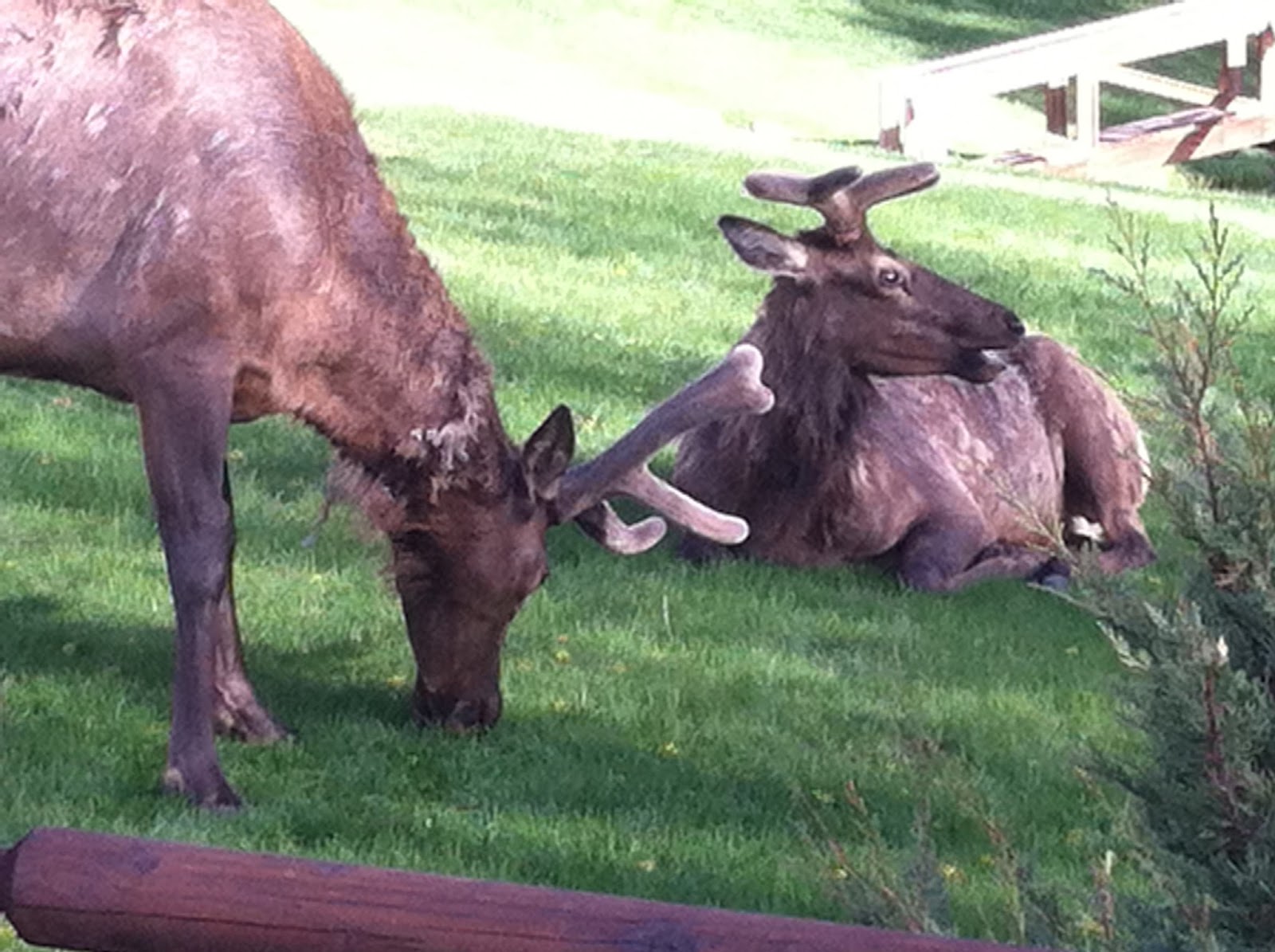
(For those who have read this far and are wondering what the elk pictures have to do with this blog post, the answer is that it's a mystery.  Isn't it cool that we were able to get THAT CLOSE to them, though?)


Thursday, May 28, 2015

Blogging the Festival - Bishop Michael Curry on love

The first time I heard Bishop Curry speak was at the Festival of Homiletics in 2009.  I believe that his sermon was titled, "We are family."  That man can preach.  This year he was scheduled to preach the first morning of the festival, and Jan really wanted to hear him.  Knowing of his dynamic preaching and learning of his nomination as a candidate for Presiding Bishop of the Episcopal Church made me want to hear him again as well.  But I had signed up for a workshop in another venue at the same time with Andrew Foster Connors on "Building a Sermon that Agitates," and in the 3rd venue Nadia Bolz-Weber was preaching and Sara Miles was giving a lecture.  How to decide?  In the end, I decided to go with Michael Curry.  Though I wish I could have heard the others, I have no regrets.  Did I mention that that man can preach?

Now that I have some distance from the festival, many of the specifics of both sermon and lecture have deserted me, though I did take a few notes during the lecture that I will share.  Bishop Curry likes to use songs in his preaching, and the lecture, which was really more like an extended sermon, was titled, "Just tell the love of Jesus."  He used the line from "Balm in Gilead" and exhorted us to tell the love of Jesus.  He said that the opposite of love is not hate but selfishness - placing myself in the center of the world instead of God.  He suggested that if we spend our time loving God and loving our neighbor, then there's no room left over for selfishness - and "when I love you, I love me too."  His delight in some of the things that he said almost rivals the joy I have seen on the occasions I've been in the presence of Archbishop Tutu. 

Bishop Curry said that when we love God and love our neighbor, we become our true selves because we discover the image of God in ourselves.  He talked about God being a unity that embraces diversity, a community of love in Godself and that the reason we are here is that God is love and the nature of love is to make space for the other.  Interspersed between all of his great one-liner nuggets of wisdom, Bishop Curry told stories and wove scripture and quotes into the fabric of what he was saying.  It all tied together, each piece building on what had come before.  He has a way of speaking with every increasing passion, building up, up, up, and then ever so gently bringing it back down because we simply wouldn't have been able to sustain listening to that level of exuberance the whole time.  Masterful. 

He talked about justice and how it needs to be done because that's what love demands, but that the end result must always be reconciliation.  Close to the end of his lecture, he told the story of Attorney Barbara Winters who heard gun shots ring out on her way to work in Ottawa last October, and, using her medic training, tried to save the soldier guarding the war memorial who had been shot.  Several others had also come to his aid.  As he lay there dying, Winters kept telling him that he was loved, that his family loved him and that all the people working on him loved him.  "You are so loved," she told him.  That was what he got to hear as he left this world. 

You are so loved. 

"Love can transcend this world from the nightmare it often is to the dream God has for it..."  Bishop Curry ended by singing "There is a Balm in Gilead" and having us all join him.  It was very powerful.  What he said wasn't new and innovative, but the way in which he took us on a journey of words and emotion truly inspired me.  On our break I went up and introduced myself to him and told him where I was from and that I'd be praying for him as he engages this journey of the presiding bishop election.  He told me that he'd gotten a speeding ticket in our diocese.  When I told him that I work with people in recovery from addiction, he said, "Ah, then you know the balm in Gilead, don't you?  Keep doing what you're doing."

Thanks, Bishop Curry.  I have never heard any of the other candidates for presiding bishop preach, though I have read books written by a couple of them.  I also don't get a vote.  With no offense or disrespect intended to the other bishops, however, I think that the Episcopal Church could use a strong dose of Bishop Curry's inspirational presence.  He told the love of Jesus on that Tuesday morning at the Festival of Homiletics.  And I, for one, am grateful.

Thursday, May 21, 2015

Blogging the Festival - Initial Thoughts

Last week Jan and I attended the Festival of Homiletics in Denver.  It fortuitously coincided with my niece's Confirmation in the Lutheran Church on Sunday, so I was able to enjoy family time and support my niece as well as being inspired by excellent preachers and speakers during the week.  I had been to the Festival when it was in Atlanta in 2009.  The keynoters that year were Archbishop Tutu and Barbara Brown Taylor.  This year it was Nadia Bolz-Weber and Sara Miles.  The theme this time was "Preaching from the Mountain:  Heralds of Good Tidings."  Pretty much if you include the word, mountain, I'm in!  I was pretty excited to be returning to Denver and the Rockies.

The first time I attended the Festival, I remember being overwhelmed - like drinking from a firehose.  There are 3 venues with speakers and preachers running concurrently, and attendees have to choose between preachers like Nadia and Michael Curry or David Lose and Brian McLaren or Will Willimon and Craig Barnes.  No matter who you choose, you're going to miss out on something great.  But you'll also be hearing something great, and I have learned to trust that wherever I choose to go, I will hear what I need to hear.

When I first began discerning my call to ordained ministry, I didn't think I could ever preach a sermon.  I had no confidence in my ability to say anything worth hearing.  I remember one session with my pastoral counselor (who was a Methodist minister,) in which I rattled on at great length about my anxiety around preaching.  She looked at me and said, "Okay, let's work on this.  If you were going to preach, what is the first thing you would do?"

"Well, since I'm in a lectionary based denomination, I would read the passage first."

"Great," she said, "And what would you do next?"

"Well, I think I'm supposed to look up a bunch of Greek words and figure out what they mean and then start reading commentaries and..."

"Stop right there," she said.  "They can teach you all that in seminary.  Go get a Bible off the shelf and let's look at a passage."

She then took me through a passage of scripture in which we read it out loud and she asked me questions about who I related to in the story, what would it have been like if I had been there, what were the questions I had, what images stuck out.  She asked me how it related to me.  And as I answered, she told me I had the beginning of a sermon.

It wasn't so hard after all.  In consultation with a mentoring priest, I chose a passage from the daily office about Jesus finding the lost sheep, and I wrote my first sermon while sitting in the backyard of my house in Norfolk.  It was actually fun!  I never preached that sermon, but it gave me the confidence to preach at my internship church when I was in the ordination exploration process.  As much as I angsted and worried and practiced that sermon, I found when I was done that I loved preaching.  And then I slept for 4 hours!  Ever since then I have felt a call to preach.

Attending something like the Festival of Homiletics is very humbling though.  I have received many compliments for my preaching over the years, the best of which are when people tell me they really thought about something in the sermon or that something changed for them.  I'm always grateful then that God has spoken to them through me.  But my ego also loves the praise, and I get to thinking of myself as an especially gifted preacher.  It never hurts to get a reality check.

The preachers at the Festival are phenomenal.  The first time I went I wanted to give up.  I felt that I didn't even belong in the same category with these people.  I was so intimidated that even though I had been inspired by all I had heard, I found writing my next sermon extremely hard because I had all these expectations.  You see, I think I have an African American preacher deep in my soul just waiting to be heard, only I'm a white girl manuscript preacher.  Whenever I have a chance to speak without notes, the Holy Spirit gives me silence, not words of wisdom.  And so I long to give passionate, inspiring, extemporaneous sermons, but it's just not who I am.  Maybe one day, that will be my gift, but for now, the Holy Spirit and I meet in the writing process. 

And so, as I come back down from the mountain, literally and figuratively, I am preparing 
to write a sermon for that most holy of days, Pentecost.  I pray, as I always do, that I will get out of God's way, and that God will help God's people hear what they need to hear, regardless of what it is that I say.  I give thanks for the opportunity to go up on that mountain, to hear the brilliant preachers, to learn new ways, to hear God say to me what I needed to hear, and to be renewed and restored.  I will blog more  about what I learned, but today what I feel is gratitude for each preacher out there who dares to take the risk to step into the pulpit or onto the chancel step or out into the aisle and proclaim the good news, to be a herald of good tidings, to speak the words of truth in love.  Thanks, God, for taking us up on the mountain, and then for bringing us back down again to share our experience with others.